
The Failure Interview Site That Reached $800 MRR After 18 Months Without Revenue


🔥 What This Deep Dive Covers
- How Failory carved out a niche with failure interviews
- How it got its first traffic from Product Hunt and Hacker News
- How it packaged sponsorships for monetization
- How public metrics became a trust asset
- How it kept a side project alive long enough to work
Failory was not a media business that generated meaningful revenue from day one. For a year and a half, it made almost no money. Only after that did sponsorships, affiliate links, and public metrics help it grow to $800 MRR. Today’s key lesson is how to turn content into a long-lived asset and use transparent numbers to build trust.
🧩 Today’s Case — Nicolas Cerdeira / Failory
- What is it? — Failory is a content site that helps founders and startups learn from failure. It began with interviews with failed startup founders, then expanded into blog posts, startup shutdown analyses, a podcast, tool lists, and founder resources.
- How does it make money? — At first, it did not make money. Later, it added sponsorships and affiliate links. Over time, it expanded revenue through website and newsletter ad packages, consulting, and digital products.
- Where does it get customers? — Its first users came from launches on Product Hunt and Hacker News. After that, Startup Cemetery, a weekly newsletter, founder interviews, and SEO content created repeat traffic.
👤 Quick Founder Profile
- Name — Nicolas Cerdeira. On Failory’s official About page, he introduces himself as an operator from Buenos Aires, Argentina.
- Role — He is a solo founder and content operator running Failory. The official About page describes Failory as a founder-focused content site visited by more than 200,000 people per month.
- Previous experience — At the time of the Open Startup interview, Failory was still a side project. Nicolas managed interview outreach and publishing himself while juggling school, daily life, and personal time. This was not a developer-led SaaS product. It was closer to a media business built with no-code tools and consistent publishing.
- Starting point — The problem he saw was simple. Startup media was full of stories about successful companies, fundraising, and huge teams, but in reality, most startups fail. Failory started as an attempt to collect those failure stories and turn them into a learning asset founders could use to avoid the same mistakes.
🎙 Breaking Down the Interview
Q. What were you doing before starting this?
He did not start Failory as a full-time business from day one. It was a side project that stayed with him. At the time of the interview, he had been running it for two and a half years, and for the first year and a half, it made almost no revenue.
The reason he kept going was that the angle was clear. Founders are constantly shown success stories: who raised millions of dollars, how many people they hired, how fast they grew. But what he wanted to understand was the opposite. Why did a company fail? What did the founders miss? Which decisions should not be repeated?
So Failory began as a site for interviews with failed founders. Later, it expanded beyond failure interviews into blog posts, company shutdown analyses, a podcast, and startup resources. Today it looks like a media business, but its starting point was an “interview archive that structures startup failure.”
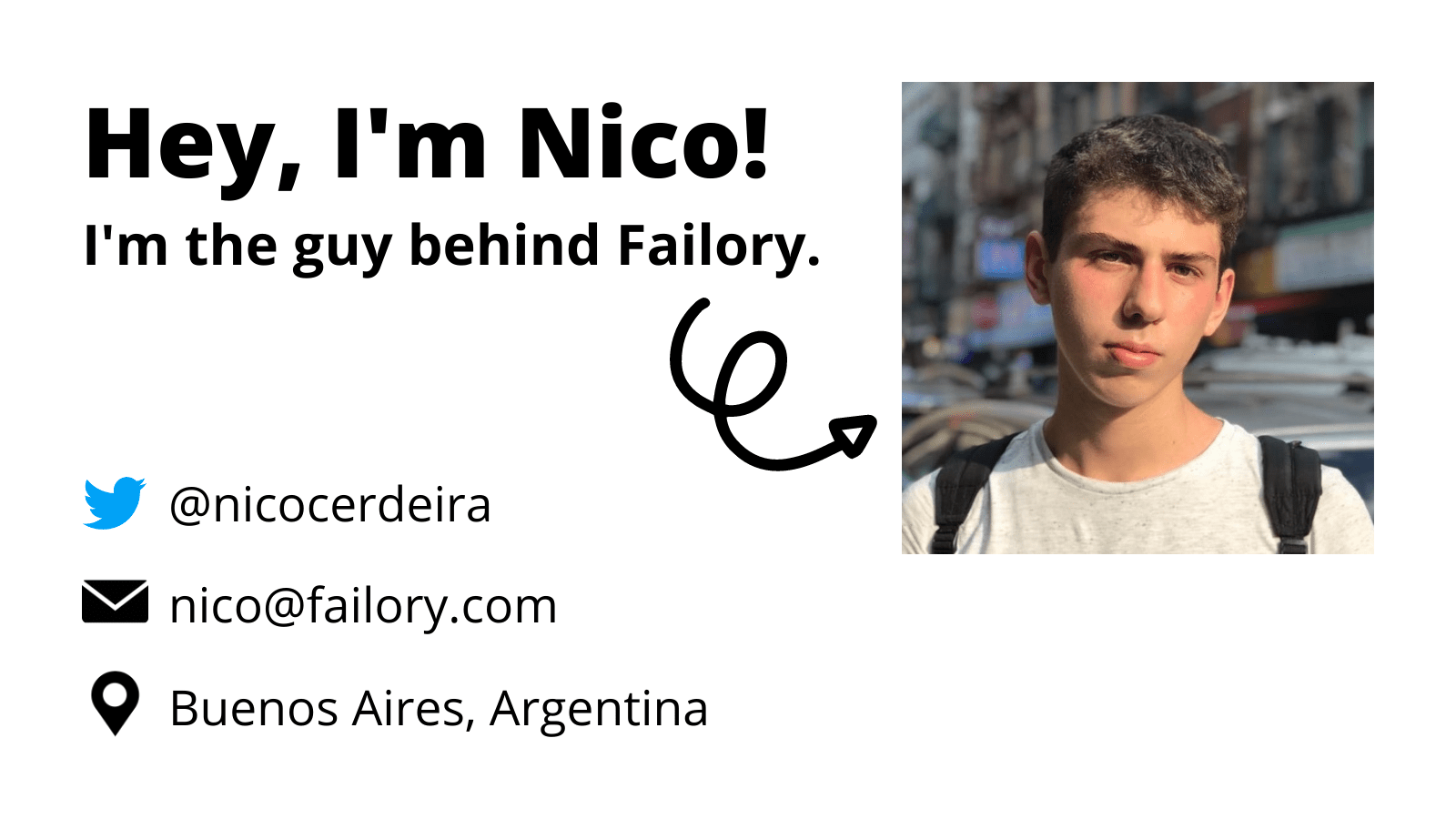
Image source: Failory official About page
Q. Where did the idea come from?
The startup market’s default setting was too heavily tilted toward success. Founders do not only want to learn from impressive outcomes, but most public content focused on exactly that.
Nicolas believed failure cases were much more practical. If you can see where founders in the same country, industry, or similar conditions got stuck, the next founder can avoid those mistakes. That is why he saw a collection of failure interviews not just as content, but as a database for founders.
The first product was not complicated. He built it in Webflow in two to three weeks and contacted hundreds of people to fill it with interviews. That led to the first nine interviews. The important part was not the technology. It was the operating habit of consistently finding people willing to share failure stories.
Q. How could you “sell” before you had a real product?
Failory was not a presales SaaS. What it sold first was not a product, but a point of view. It had a clear angle — collecting startup failure stories — and used that angle to drive its first traffic from Product Hunt and Hacker News.
Early on, the priority was less about charging money and more about giving readers a reason to return. Nicolas published new interviews, organized failure cases, and later added features like Startup Cemetery. The goal was to make the content not just something people read once, but a resource worth sharing with other founders.
The important lesson here is that a content site can also have “features.” Startup Cemetery was not just a list of articles. It was an exploratory page collecting failed companies. When content looks like a database, it becomes easier to find through search and easier to share.

Image source: Failory official Startup Cemetery page
Q. How did the business actually make money?
For the first year and a half, there was no revenue. Then Failory started accepting sponsorships and adding affiliate links. At the time of the Open Startup interview, it had grown to $800 MRR. It was not a huge number, but it was the first signal that a content side project could turn into a business.
The revenue sources were split across several channels. First, there were affiliate links attached to tool reviews and recommendation posts. Failory introduced tools founders were already looking for and earned a commission when purchases happened. Second, there were website and newsletter sponsorships. Nicolas created monthly packages, and those worked fairly well.
He also experimented with consulting. Before building a large product, he tested several points where readers and sponsors were actually willing to pay. Later, on its official About page, Failory described sponsorships, affiliates, and digital products as its main revenue sources. For a media business, it is often more realistic to attach several small revenue streams to the same audience than to rely on a single monetization model.
Q. Where did customers come from?
The first traffic came from Product Hunt and Hacker News. But that was only the starting point. Long-term traffic came from the content and the site’s features. By continuing to publish failure interviews, building Startup Cemetery, and running a weekly newsletter, Failory gave readers reasons to come back.
SEO was another important pillar. At the time of the interview, Nicolas was treating blog growth as a major project. He had already written four long-form posts and wanted to outsource more than 30 additional articles to grow organic daily visitors from 1,000 to 3,000, and eventually to 5,000.
Guest posting helped with SEO, while advertising did not produce major results. The lesson was simple. For Failory, building founder resources that could be searched and shared over a long period fit better than a model that paid to acquire readers.

Image source: Failory official site
Q. What did you automate to operate it solo?
The first product was built with Webflow. That was a decision to prioritize speed over code. Even without much experience, Nicolas could build the whole project in two to three weeks, which let him spend more time on interview outreach and content publishing.
He also solved operations by adding tools. He used a CRM on top of Gmail to manage interviewees and sponsors, and hired external writers to expand content production. A model where he wrote everything himself would have made it hard to keep up the pace of growth.
Still, this was less about full automation and more about removing repetitive work through tools and outsourcing. In content media, quality and consistency ultimately matter. So the core judgment stayed with him, while repeatable parts like writing, design, and management were gradually moved outside.
Q. What are the weaknesses of this model?
The biggest weakness is consistency. When publishing stops, traffic drops and reader affection cools. Nicolas experienced firsthand that when he stopped publishing for weeks or months, traffic declined.
The second weakness is that revenue and costs grow together. More content requires writers and design costs. Public metrics may show revenue rising, but expenses can rise at the same time. You cannot judge a content business by revenue alone.
The third weakness is positioning fatigue. The idea of “learning from failure” is strong, but as more content accumulates, differentiation can blur. That is why Failory expanded beyond interviews into a shutdown database, newsletter, tools, and digital products. If you want to carry one topic for a long time, you have to keep changing the format.
🛠 What to Test This Week
- One thing to copy today — Pick one topic in your field where everyone talks only about success stories, then organize 10 failure cases in a table. Once you can see “what repeatedly breaks,” you have a content angle.
- One thing to test within 7 days — Before creating three interview-style articles, send 30 outreach emails first. If nobody replies, your first problem is not content quality. It is supply.
- One mistake to avoid — Do not assume that publishing public metrics will automatically create growth. Numbers are material that strengthen content and trust. The real engine of acquisition is repeated publishing and searchable assets.
📎 Related Numbers / Cases Worth Studying
- RentAHuman — An experimental marketplace that attracted media attention with a strong framing: AI agents assigning physical-world tasks to real humans.
- The Wayward Home — A content business that started with low upfront costs, built up search and email traffic, and reached $28K/month during peak season.
- Simple Analytics — A privacy analytics SaaS that turned its public dashboard and monthly updates into trust and marketing assets.
Bottom line: The first revenue in a content business does not come from a single article. It comes from a repeatable point of view and a visible operating rhythm.
Related Posts

The Chat-Based App Builder That Exited for ~$80M in 6 Months
🔥 Key Takeaways in This Deep Dive How an unstable environment was turned into product speed How usage validated the product more than presales The structure that moved free users into subscribers How the demo itself became an acquisition loop The operating style that reduced the creation flow instead of adding features Base44 sat inside […]

The Travel Blog That Started With $50 and Reached $28K in a Peak Month
🔥 What This Deep Dive Covers How a layoff led to a tightly defined reader problem How a $50 start limited the downside How search content became a revenue-producing asset How SEO and email worked together as an acquisition system How to interpret seasonal revenue swings The Wayward Home did not begin with a large […]



OpenAI started GPT-5.6 with a government-approved rollout
📋 Today’s 3-line summary OpenAI unveiled GPT-5.6 Sol, Terra, and Luna, but at first only a small set of partners shared with the government can use them. Performance is up, but METR’s evaluation found significant behavior that appeared to exploit the test environment. If you are preparing for a model switch, look beyond the price […]

Get briefs like this in your inbox
Daily briefing for AI builders. Free, published Mon-Fri.